
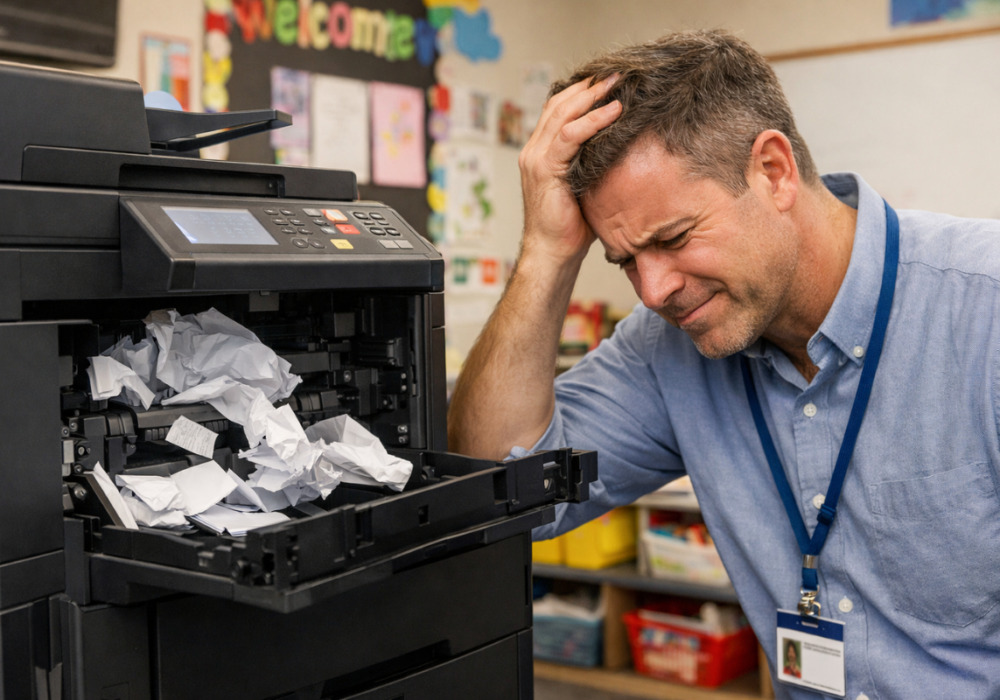

Why Cheap Paper Causes Printer Jams in Schools and Trusts
Every school relies on its printers. From lesson plans and student reports to policies and parental letters, the printer is the quiet engine of day-to-day operations. When it works, everything flows. When it doesn’t, disruption spreads quickly, whether that be lost classroom time, wasted resources, staff frustration, or urgent calls to IT.
Across many schools and trusts, one of the most common frustrations remains the same: frequent paper jams. While it’s easy to blame the machine, the real cause often lies in a place few people think to look – the paper itself.
Printer performance is directly influenced by paper quality. When cheaper paper is used, problems begin to appear. Not immediately, but gradually and almost always at the busiest moments.
Understanding why this happens is the first step towards building a more reliable and cost-effective print environment for your school or trust.
The Hidden Problem: Dust and Debris
Lower-cost papers are usually made from less refined pulp and compressed to a lower density. The result is a looser structure, with fibres that detach more easily as the paper passes through the printer.
These loose fibres generate a fine dust that settles on rollers, sensors, and gears. Even small amounts of this dust can interfere with how smoothly paper feeds, how accurately it aligns, and how consistently a job completes.
In a high-volume environment like a school, where thousands of sheets move through each device every week, this build-up happens quickly. Over time, it causes jams, misfeeds, and even premature wear of internal components.
What begins as an occasional inconvenience can soon become a pattern of breakdowns, service calls, and lost productivity.
Paper Weight and Thickness Matter
To reduce costs, many low-priced papers are manufactured thinner and lighter. The difference might not be visible to the eye, but it matters to a printer’s mechanics.
Feed rollers depend on a certain stiffness to grip and guide each sheet. When paper lacks this rigidity, it can slip, skew, or feed several pages at once, all of which trigger jams or misalignments.
These issues are especially common in older printers and multifunction devices, where feed mechanisms are more sensitive to inconsistencies in paper thickness.
The result? More interruptions, wasted paper, and avoidable strain on machines that are already working hard.
Surface Texture and Friction
Cheaper papers are often rougher in texture. That roughness increases friction as each sheet moves through the print path, forcing rollers and guides to work harder.
Over time, this added strain accelerates wear and tear. Feed rollers lose their grip sooner, components fatigue faster, and friction-induced heat contributes to further degradation.
The smoother the surface of the paper, the easier it travels and the longer the printer lasts.
Why Higher-Grade Paper Performs Differently
Premium papers, such as Envirocopy, are engineered for reliability in high-demand settings like schools, academies, and multi-site trusts.
Envirocopy is made from Eucalyptus globulus fibre – short, uniform, and naturally strong. This structure creates a dense, consistent sheet with fewer loose fibres, which dramatically reduces dust generation.
The result is a paper that feeds cleanly, maintains alignment, and minimises wear on internal components. Its balanced thickness ensures smooth duplex printing, while higher opacity prevents ink show-through, allowing both sides of the page to be used effectively.
It’s a paper designed not just to look good, but to perform well – every day, across every printer in your network.
The Hidden Cost of “Saving” on Paper
Budget pressures often make it tempting to choose the lowest-cost option. Yet what appears to be a saving at the point of purchase can become an ongoing cost in time, maintenance, and disruption.
Every jam means lost minutes. Every service call takes a technician away from more strategic IT work. Every reprint consumes more toner, paper, and energy.
Over a term or across multiple schools these small interruptions add up to significant resource loss. And because poor-quality paper can accelerate mechanical wear, it may also reduce the lifespan of printers and void elements of service agreements.
In contrast, higher-grade paper reduces callouts, downtime, and overall usage. The investment pays back in smoother operation and lower total cost of ownership.
Consistency Across Multi-Academy Trusts
For MATs, consistency is key. Different paper grades across schools can lead to unpredictable performance, variable print quality, and an inconsistent user experience.
By standardising on a high-quality paper like Envirocopy, trusts achieve:
· Reliable printer performance across all sites
· Reduced IT support demand
· Simplified procurement and inventory control
· Consistent print presentation in communications and reports
It’s a small operational choice that delivers trust-wide efficiency, ensuring every site benefits from the same dependable results.
What to Look For When Specifying Paper
When choosing paper for educational environments, focus on these five attributes:
· Weight: At least 80gsm for stable feeding and opacity
· Surface: Smooth, even finish to minimise friction
· Opacity: To enable double-sided printing without show-through
· Fibre Quality: Dense and uniform to resist dusting and shedding
· Sustainability: Recycled or responsibly sourced, with environmental certifications
Envirocopy has been designed with each of these in mind, supporting both performance and environmental responsibility – two priorities that increasingly go hand in hand.
Smarter Procurement Starts With Better Choices
Printer jams and feed errors aren’t random. They are symptoms of consistent variables and paper quality is one of the most influential.
By selecting the right paper, schools and trusts can improve efficiency, reduce downtime, and protect their investment in equipment. More importantly, they can create a smoother working day for teachers and staff who depend on reliable printing to deliver lessons and manage administration.
Small changes like this build stronger systems saving time, reducing waste, and keeping attention where it belongs: on teaching and learning.
Explore Better Paper Options
Springfield Papers is proud to supply Envirocopy, a high-performance, sustainable paper trusted by schools and MATs across the UK.
If you’d like to test the difference in your own printers, request a free sample pack and see first-hand how smoother paper creates smoother days.